Powered By Blogger

Wednesday, 21 March 2012

Documentary Roles

This is the first time that I have worked with any of the people in the team. The roles are as follows:
Katie Watts: Producer
Ben Brown: Director
Benjamin Wilson: Editor
Connor Elliott: Cinematographer (DOP)
Lucy Smith-Jones: Sound Recording and Design

For my role as producer, I decided to research what my responsibilities and duties would be. I read the book 'What a Producer Does: The art of moviemaking (not the business)' by Buck Houghton.

I identified my main duties as follows:
  • To research the subject and arrange collaborators for the film.
  • To schedule shooting times from location to location with various collaborators.
  • To complete a risk assessment in order to be covered and prepared for all eventualities.
  • To act as a production manager and co-ordinate the rest of the team.
  • To organise the booking-out and acquisition of equipment and props.
  • To create shot and sound logs that can be filled in during shooting to make the editing process easier. 
  • To ensure that all collaborators and location managers have signed release forms to cover us and the collaborators themselves legally.
  • To co-ordinate the post-production process, during which regular tutorials will be organised and regular production meetings with the whole team would occur. 
In addition I took on an extra role of DVD authoring. I felt that my role had very little creative input, so I asked Ben Wilson (editor) if I could help a little with the post-production process and author the DVD on DVD Studio Pro (a programme with which I have become adept). 

Documentary Final Idea

As a group, we began to search for news stories in the Liverpool area that would reflect all of the research that we had done into portrait video and personal stories.
Many ideas came across, but the one that really caught our eye was to do with the upcoming Liverpool Tattoo Convention in May. We thought that we could explore personality and personal experience through body art, much like the style of James Lees' 'Pockets', but with tattoos.
Liverpool Tattoo Convention Website
On the 29th February, as Producer of the film, I travelled to Liverpool to try and talk to some tattoo artists, in particular those from Design 4 Life studio, who were organising the convention. However, Design 4 Life had too many commitments to do with the convention and decided to decline participation in our film with respect and well-wishes.
In preparation for the recce trip, I had compiled a list of tattoo studios in Liverpool and so I carried on talking to artists and shop managers, and most studios were wary of taking part in our film because the equipment and interviewing would distract from the work that the artists are trying to do. However, I met a lovely lady named Lisa who ran a studio called Dermagraffiti, and was planning to set up a Liverpool Tattoo museum with her husband. She agreed to allow us to interview her and one of her artists, Yasmeen, and both would be visually dramatic to look at in the film.

Dermagraffiti Website
Returning to the team with just one studio confirmed, we decided to use the ladies at Dermagraffiti as a thread throughout the film, and would use voxpops for the main bulk.
Artistically we decided to only include visuals of the subject speaking from the tattoo artists, coming from a metaphorical point that the artists are the ones with the power to make or break a tattoo and are the ones with the voice. For the voxpops we would film visuals and record interviews separately and layer the voice over naturalistic behaviour of the subject.
I arranged to meet Lisa on the afternoon of our arrival in Liverpool and meet Yasmeen the next morning, and for the rest of the day we would go out looking for normal people to film and talk about their tattoos.
Stylistically, we decided to take severe inspiration from 'Pockets', and in fact produce a homage to it. We would use soft lenses to focus on the subjects and blur the backgrounds, and felt that this would bring out colour in the tattoos and the people. The fact that the piece would be optimistic was important to us because we want the viewer to feel lifted from the start of the film, and listen to the stories behind the art that contributes to who the people are today.

Documentary Experiments with Photography

(text copied from the handwriting on the pages of my sketchbook)

Experiments in Instant Photo
For the documentary project, it is important to 'document' life as it can really be seen, even if that means showing something real from a specific or constructed view.
I have my own Fujifilm Instax camera and I felt that the medium of instant photography really epitomised the capturing of life in one opportunity.
I decided to capture people in an environment in which they don't know that they are being photographed.
This first experiment is a technical one - searching for settings on the camera that would create a well-shot photograph. Composition is also important here and I have tried to set up a shot with meaning beyond what you can see in the frame.

 This was my first attempt to capture a moment of life and people in their own day. I used the 0.9-3m distance setting and the 'lighten' function on the camera. This made the branches in the foreground clear while the background is blurred. The exposure function seems to have had little effect due to the confusion of light areas and dark areas.


The second photo was taken using the 3-infinity m function and the 'normal' exposure setting. All elements of the picture are clearer and the sunny areas are not too hot, however the foreground is still quite dark compared to the rest of the frame.


Composition: I used the branches and wall in the foreground to represent a surveillant mood. I like how you cannot see any faces - it disconnects the subjects from the viewer of the photograph. I think that the geometry of the photo is also interesting: the lines all lead to a perspective point on one side of the frame, and on the right of the frame all of the lines are horizontal.


Experiments in Landscape
People and Places. I decided to do two experiments with my instant camera. The first was to take in movement and personality within a particular landscape in which that environment is prevalent. The second was to capture an empty environment and experiment with man-made habitat and industrial shapes.


I like the sense of being in this place that comes across in the photograph. There is a sense of life in motion and the circular lines on the floor draw the eye to the fountain in the centre and the children playing around it. There is a sense of off-screen activity with the person walking into the frame and this makes us aware of what is outside the frame as much as what is in it.


This photograph was taken from a moment of beauty and inspiration where the light blinded me and the camera shows more than I can see. I like the juxtaposing lines in the buildings and paving slabs and how the light hits the floor (despite the technical fault in the centre of the sun). The bird in the foreground makes the bottom half of the photo seem more three dimensional than the top half. This was the first time I had turned the camera sideways.


Experiments with Light and Dark
In these photos I experimented with shadows in order to explore the theme of identity - a theme that comes hand in hand with portrait photography and video. I decided to explore the issue of race, inspired by Eve Arnold's art photography from the American Civil War. I used the brick wall as a background to represent the building blocks from which our ethnicity is created.

Here I used a white man laughing into shadow to represent old fashioned ideas about race and ridicule.
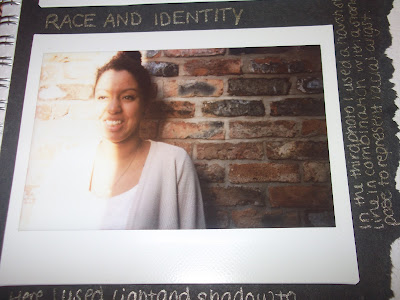
Here I used light and shadow to represent the mixed race heritage of this girl's skin.
In the third photo I used a harsh shadow line in combination with a stand-offish pose to represent racial angst.
Identity and Opposition
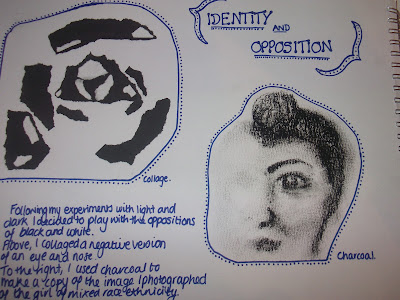
Following my experiments with light and dark, I decided to play with the oppositions of black and white. I collaged a negative version of an eye and nose. 
I used charcoal to make a copy of the image I photographed of the girl of mixed race ethnicity.


Sunday, 18 March 2012

Documentary Research - The Family in British Art

Have been to see the Family in British Art exhibition at the Millennium Gallery in Sheffield. Two pieces in particular caught my eye.

Firstly, a photographer called Jonathan Turner was commissioned to photograph Sheffield Families and what 'family' means to them.
Unfortunately I can't show any photos on here as the collection is not available online yet.

Secondly, one piece of video art gave me the idea to play with sound in the film. It was a piece in which two brothers are talking about their mother and a mother talking about her boys, but the voices had been recorded and the opposite party had lip synced what they were saying (so we would see the mother speaking in the boys' voices). I would like to play with sound so that the portraits in the film are more visually interesting: we are not just watching one person talking about themselves. This could possibly mean seeing the people acting naturally and hearing their voices over the top. It could also involve some sort of juxtaposition in which the person's face does not reflect the manner in which they are speaking.

Again, the video is unavailable online.

Documentary Research - Jim Goldberg

Another photographer who I very much admire is Jim Goldberg, who won the Deutsche Borsche Prize in 2011 for documenting refugees. In particular I am interested in his relationship between image and text, both within the photograph and around the edges of the frame.

Greece. Lavrio. 2005. Detained Afghani refugee shows scars recieved from Taliban torture. Lavrio Detention Centre.
Democratic Republic of the Congo. 2008. His radio is his sole possession that he took with him while escaping a rebel attack in his village.
Ukraine, 2007
USA. San Francisco. 1979.
It is possible to interact text and video image in the documentary, however, the first photograph shown here has given me thoughts about body art (where the skin has been drawn on), and in particular, collage. I like the idea of creating a visual collage of people and life stories and possibly this could be based around tattoo art...

Documentary Research - Eve Arnold

When thinking about character studies, there was no better artist that I could think of than photographer Eve Arnold, who died last year.
Aside from the fact that she is one of my favourite artists, Eve Arnold was one of the first to move away from the staged portrait photography and capture the natural essence of the subject through capturing them in their most comfortable environment, whether that be Marilyn Monroe on set, Marlene Dietrich in the studio or a mother with her newborn child.

Marlene Dietrich at the recording studios of Columbia Records, 1952

Bar girl in a brothel in the red light district, Havana, Cuba, 1954

Widow Needing Companion: Dora Grubb and amateur painter at the Royal Academy of Arts, London , 1961

Eve Arnold on the set of Becket, 1963

Dubai, United Arab Emirates, 1971

Horse Training for the militia, Inner Mongolia, China, 1979

Marilyn Monroe

Margaret Thatcher electioneering in the Orkneys, 1977

Mother and baby's hands, first five minutes of life, Port Jefferson, Long Island, 1959

Although Arnold worked very closely with celebrities such as Marilyn Monroe, Joan Crawford, Elizabeth Taylor and Margaret Thatcher, to name a few, she spent much of her later career travelling the world and capturing the lives of many faces of many cultures, including some political photography.

My favourite photograph of hers perfectly captures not only the emotions of the subjects, but also the mood of the social situation at the time of the American Civil Rights Movement.

School for black civil rights activists; young girl being trained not to react to smoke being blown in her face, Virginia, 1960

Friday, 16 March 2012

Documentary Grouping and Inspiration

Upon being given the documentary brief 'Liverpool Stories', I immediately set about trying to find a group whose mentality was similar to mine with the brief and creative inspiration. I ended up with a group that I had never worked with before, and the thing that we all had in common was that during the briefing session, we had all been massively inspired by one particular film. This film was called 'Pockets', by a filmmaker called James Lees.


Pockets from Pilgrim Films on Vimeo.


The thing that we all agreed on was that the poetic style of the documentary complimented the simple narrative and we felt that it worked better as a short film than a news-piece interview based documentary.
Pockets is a film that simply portraits miniature character studies based on the things that people in the street have in their pockets. We thought that this little slice of life was more poignant to us than most well-made documentary pieces and as a group we decided to follow this kind of a story with our own film. It was not only the narrative that had us gripped, the shallow focus and bright eye-catching soft cinematography as well as the slow editing pace made us look at common people in a whole different light - literally. For me, it had encouraged me to look upon all of these stories with a positive, calm and reflective state of mind, which made the film all the more charming.

As the next stage of my own personal inspiration research, I looked at other films by James Lees. One in particular jumped out at me from his collection on Vimeo. It was made as an introduction to a song for Shakira's live world tour, but again, the slice of life style and personality that shone through with the subjects in the video not only inspired me but changed my mood for several hours afterwards.


Shakira - Waka Waka (This Time for Africa) from James Lees on Vimeo.


In particular, I loved the use of paint powder and colour as well as the use of dialogue: to me it made for a visually dramatic piece despite the simple subject matter.

I set about trying to find other films with similar subject matter just to see the different ways that it could be done. This film was made by Rick Mereki as a tourist advertisement, but it demonstrated a different way of editing a documentary piece. The landscape cuts look beautiful, but if we were to use members of the public, this effect may be much more difficult to achieve; the reason that it works in this film is because it is one man featured.


MOVE from Rick Mereki on Vimeo.


Aside from short films, I recently watched a slightly darker character study on Channel 4. The Cutting Edge documentary was called 'Obsessive Compulsive Hoarder', about a Mr Walker in Surrey, who had hoarded about a million pounds worth of property that used to belong to his parents. I decided to include this in my research because of three key things: 1) It was a less positive story and there is still a possibility of finding a story that is sad or disturbing etc. 2) It is a single (rather than group) character study and 3) It was made in a more traditional documentary style. After watching this, I hope to find a more positive story that can encompass many members of the public, because I want to recreate the charm and beauty of 'Pockets' preferably.

Obsessive Compulsive Hoarder on 4OD